

Uncategorized
Magic mushrooms strains and how their traits compare
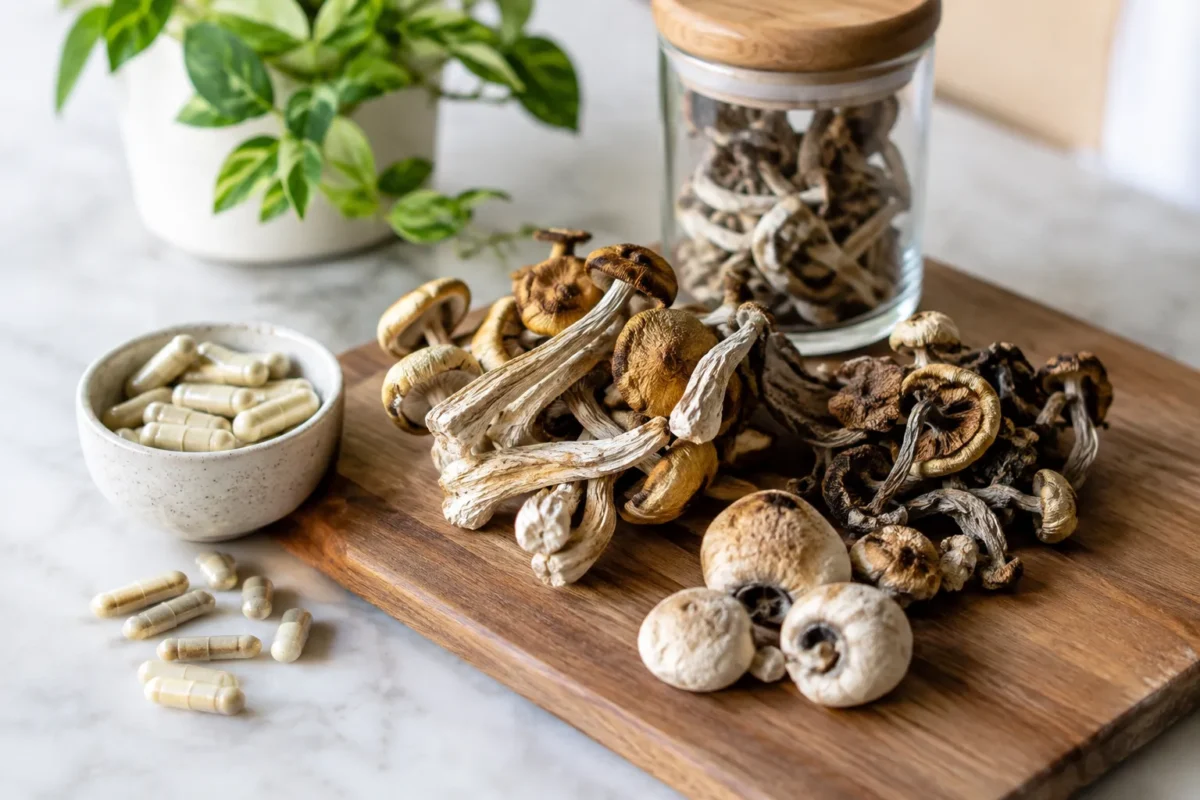
Sep

 26 Sep 2026
 12 min read
Magic mushrooms strains are often discussed as if each name guarantees a predictable experience. In reality, a label may describe a species, a cultivated variety, a local nickname, or a marketing term. Genetics, growing conditions, harvest, storage, testing, and individual factors can all affect what someone encounters.
This guide explains the main differences among strains of magic mushrooms, why names can be inconsistent, and how to interpret claims about magic mushroom effects and dry magic mushrooms responsibly. Laws and product standards also vary widely, so education should come before assumptions.
What “strain” means in magic mushrooms
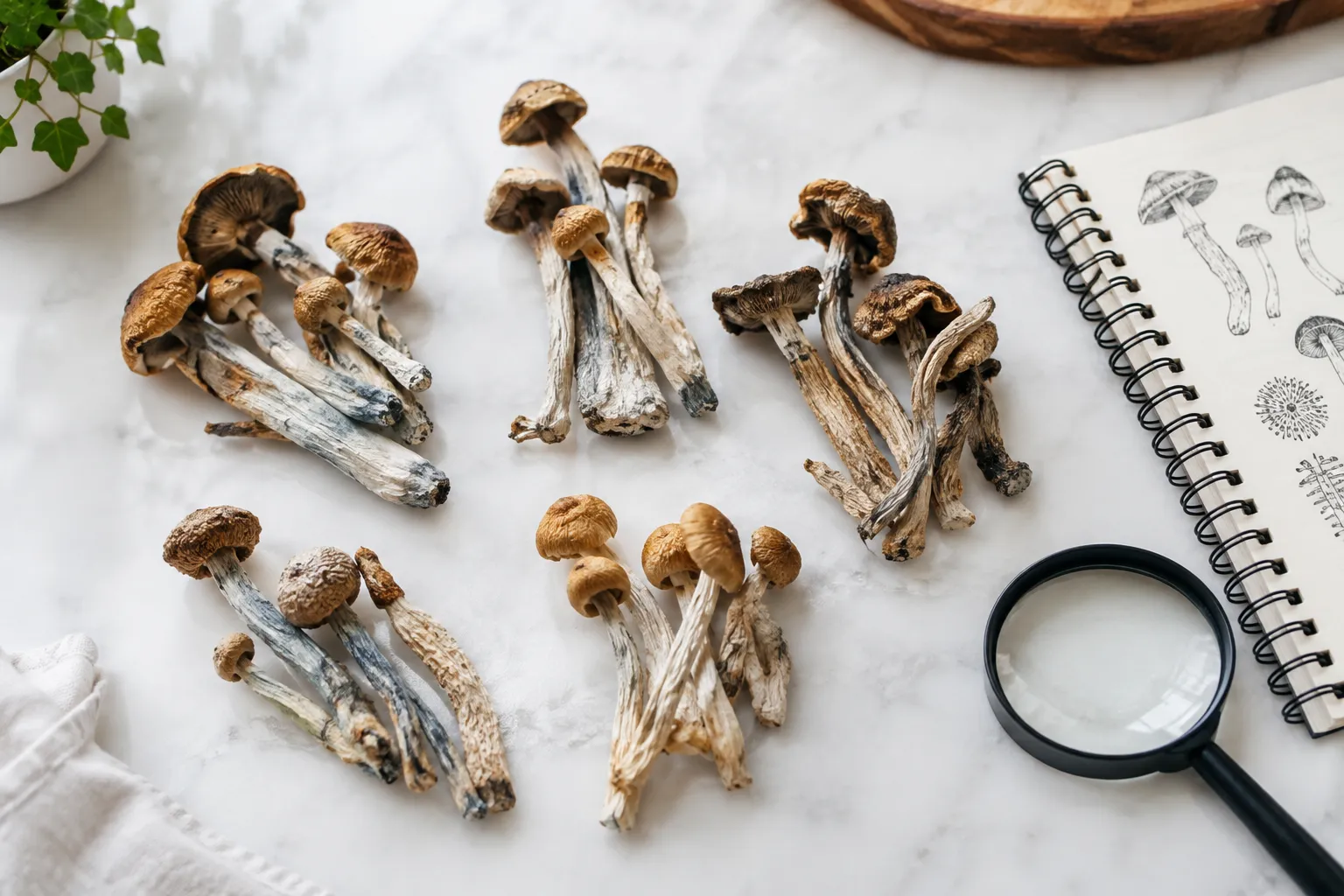
In everyday conversation, “strain” is a convenient word for a named type of mushroom. Scientifically, it can be less precise. A label may refer to a species, a cultivated line within that species, a genetic isolate, or simply a name passed between growers.
That distinction matters because two products carrying the same name may not have identical genetics or chemical profiles. A familiar name can offer context, but it cannot prove identity, potency, or expected effects.
For general information about product details, safety questions, and legal limitations, readers can review the product and safety FAQs.
Species, varieties, and marketing names
A species is a biological classification. Psilocybe cubensis, Psilocybe cyanescens, and Psilocybe semilanceata are examples of species commonly discussed in relation to psilocybin-containing mushrooms.
A variety is a narrower cultivated or naturally occurring grouping within a species. In the cubensis conversation, names such as Golden Teacher, B+ and Penis Envy are commonly used as variety or strain names. However, those terms are not always applied consistently, and they do not function like standardized pharmaceutical product names.
The word “albino” can describe a pale appearance or a cultivated line selected for lighter coloration. It does not automatically establish a separate species or reveal the mushroom’s potency. Likewise, a dramatic name does not guarantee stronger magic mushroom effects.
A useful way to read a label is to separate three questions:
- What species is claimed?
- What variety or informal name is being used?
- What evidence supports the identity and batch information?
If the label answers only the third question with a colorful nickname, there may be little reliable information to compare.
Why the same name can describe different mushrooms
Genetics are only one part of the picture. Growing substrate, temperature, humidity, light, fruiting conditions, harvest timing, and handling may influence appearance and chemical composition. Even mushrooms from the same cultivation can vary from one fruiting body to another.
Processing creates another layer of uncertainty. Fresh and dry magic mushrooms do not have the same weight because drying removes water. Drying, heat, light, oxygen, and moisture can also affect how a product changes during storage.
Labeling practices vary too. One seller may use a name for a particular cultivated line, while another may use it more loosely for mushrooms that look similar. This is why “same strain” does not necessarily mean “same material.”
The practical takeaway is simple: a strain name is a clue, not a certificate.
Major species and commonly discussed varieties
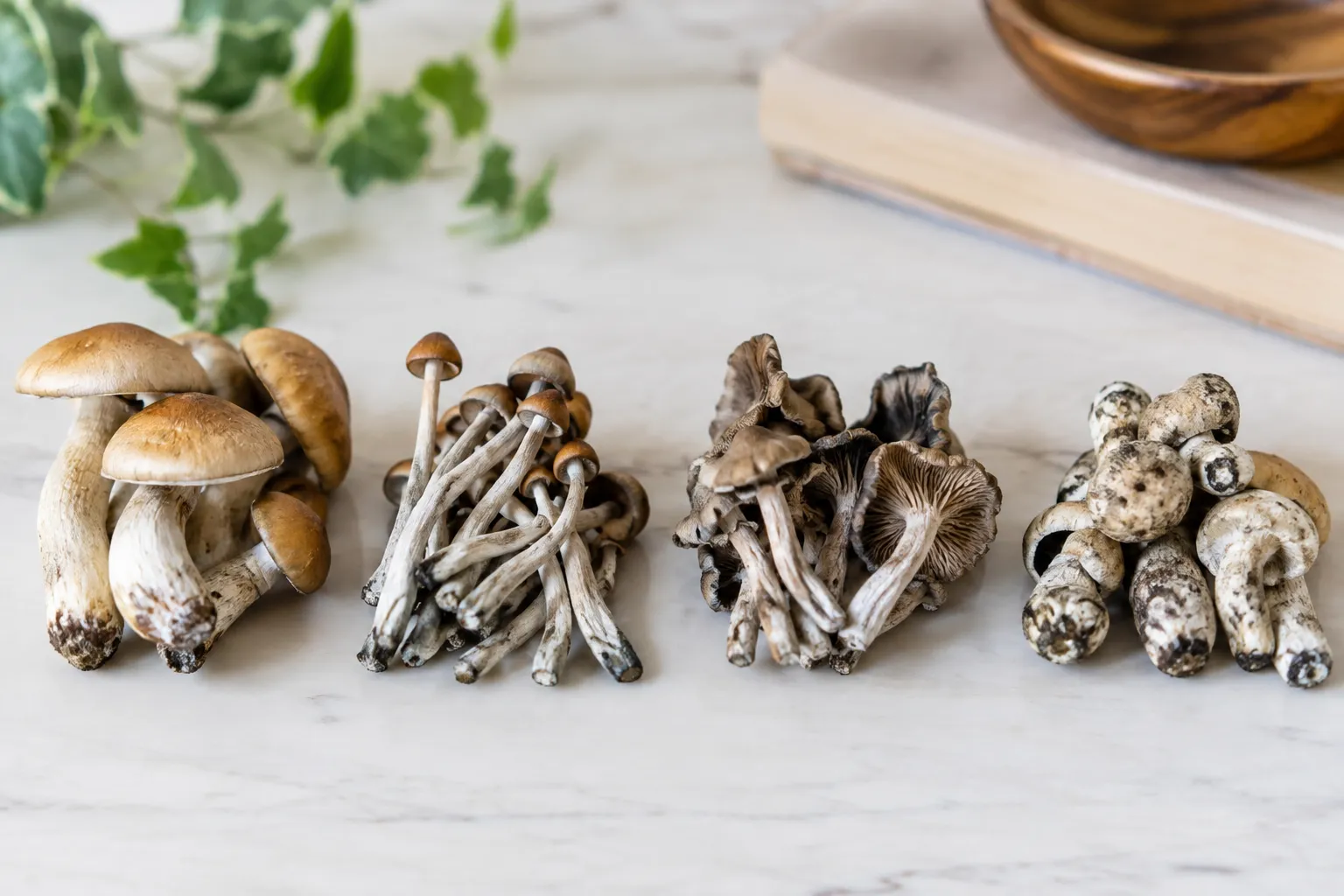
The phrase “magic mushrooms strains” usually brings Psilocybe cubensis to mind because it is widely discussed in cultivation and online education. It is not the only psilocybin-containing species, and there is no universal ranking that makes one option best for every person or context.
Species identification can be difficult from appearance alone. Online photographs and informal descriptions are especially poor substitutes for expert identification or validated laboratory analysis. Readers researching regional rules can also consult location information through Locations.kml, but local legal requirements should always be checked with current official sources.
Psilocybe cubensis and its named varieties
Psilocybe cubensis is commonly described as a cultivated species with many named varieties. Golden Teacher, B+, and Penis Envy are among the names frequently encountered in educational and commercial discussions.
People often associate these names with differences in appearance, growth characteristics, or perceived intensity. Some reports describe particular varieties as more visual, more introspective, or more energetic. Such descriptions are anecdotal and should not be treated as reliable predictions.
The same variety name may cover different genetic material. A cultivated line can also change over generations, and growing conditions may influence the final product. Consequently, a comparison between named cubensis varieties is best treated as a broad description rather than a fixed specification.
A responsible label may provide more useful information than a dramatic variety name. Relevant details can include:
- The claimed species and variety
- Whether the material is fresh or dried
- Batch or harvest information
- Available laboratory documentation
- Storage and packaging information
- Applicable local restrictions
None of these details makes a controlled substance legal or risk-free, but they help distinguish transparent information from unsupported storytelling.
Other psilocybin mushroom species
Other species often mentioned in mushroom education include Psilocybe semilanceata, Psilocybe azurescens, Psilocybe cyanescens, Psilocybe mexicana, and Psilocybe tampanensis.
They differ in ecology, appearance, cultivation difficulty, and typical growing environments. Some are associated with grassland habitats, while others are discussed in relation to wood-loving growth. These differences can matter for identification and cultivation biology, but a species name alone still cannot establish the composition of a particular sample.
Wild identification carries an additional concern: poisonous mushrooms can resemble psychoactive species. Visual confidence is not a substitute for validated identification. Misidentification can have serious consequences, so unknown wild mushrooms should not be treated as interchangeable with a labeled cultivated product.
Descriptions of other species sometimes include claims about unusually high potency. Those claims may be based on limited samples, variable methods, or anecdotal reports. Without consistent testing, it is safer to treat such statements as uncertain rather than as a dependable ranking.
How traits, potency, and effects can differ
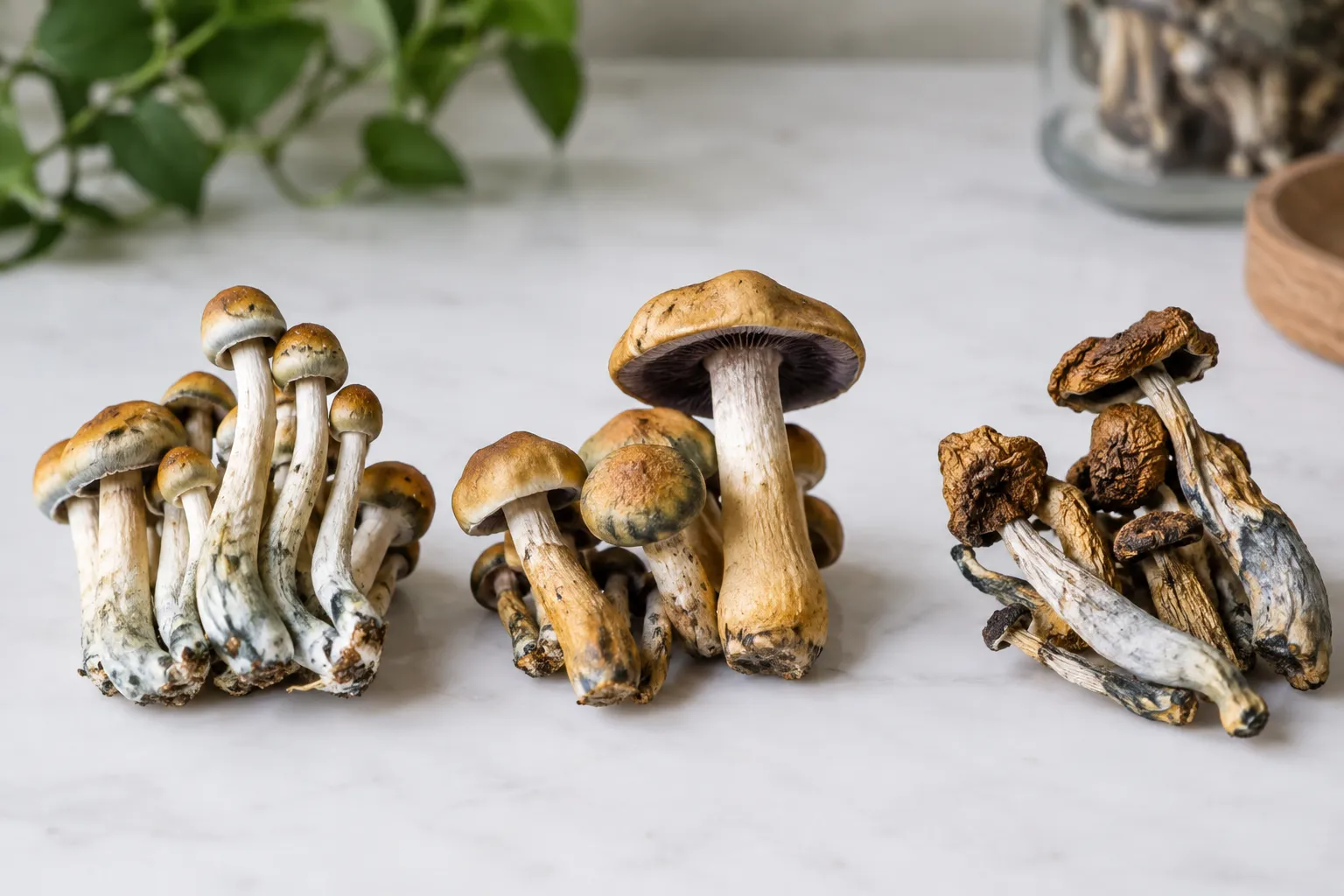
The visible traits of a mushroom do not map neatly onto its chemical profile. Cap color, stem shape, bruising, size, and density may vary within one batch, while mushrooms with similar appearances may differ chemically.
Reported magic mushroom effects can also vary because of the material itself and the person encountering it. Expectations, surroundings, mood, previous experience, physical health, other substances, and the amount taken all matter. A strain name cannot account for all of those variables.
Readers comparing psychoactive products should avoid borrowing assumptions from unrelated categories. For example, an article about best indica strains concerns cannabis terminology, not a scientific ranking of mushroom varieties. Similar-sounding “strain” language does not mean the categories can be compared directly.
What potency labels can and cannot tell you
Terms such as mild, strong, moderate, or highly potent are not standardized measurements. Without validated testing tied to a specific batch, they may reflect reputation, seller language, personal experience, or comparison with an unknown reference point.
Laboratory results can provide more meaningful information when the method, sample, and reporting units are clear. Even then, a result describes the tested sample, not necessarily every mushroom carrying the same name.
A potency label cannot reliably predict:
- How a particular person will respond
- The exact timing or duration of effects
- Whether an experience will feel pleasant or distressing
- Whether a product is correctly identified
- Whether the product is legal to possess or purchase
The strongest-sounding label is therefore not automatically the most informative one. Evidence beats theatrical naming, even when the label is less exciting.
Set, setting, dose, and individual differences
“Set” refers broadly to a person’s mindset, expectations, mood, and physical state. “Setting” includes the surroundings, social context, perceived safety, and availability of support. These factors can shape an experience alongside the mushroom’s chemistry.
Individual differences also matter. Responses may vary with age, body composition, sensitivity, previous experience, mental health history, sleep, food intake, and other substances or medications. This variability makes precise predictions difficult.
Co-use deserves particular caution. Combining psychoactive substances can make effects less predictable and may increase risks. People with a personal or family history of certain psychiatric conditions, significant cardiovascular concerns, or other vulnerabilities should seek qualified medical advice before considering any psychoactive substance.
Checking quality, legality, and product information
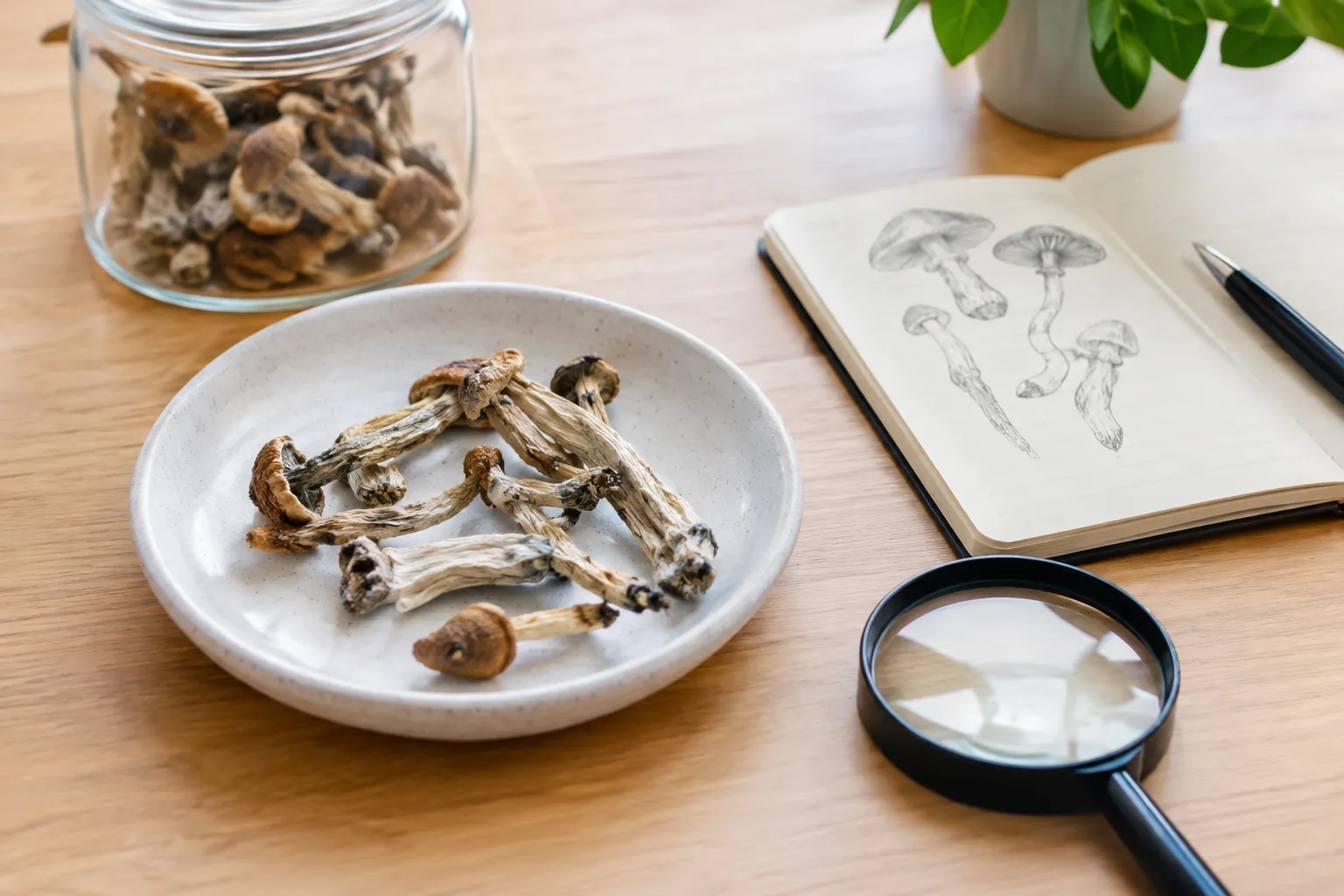
A careful review of magic mushrooms strains should examine more than appearance and a memorable name. Product information is useful only when it is specific enough to check and honest enough to acknowledge uncertainty.
A basic information checklist includes:
- Claimed species and variety
- Fresh or dried status
- Batch or lot identification
- Ingredient information for any prepared product
- Serving or amount information where legally required
- Laboratory documentation, if available
- Packaging and storage guidance
- Relevant age and location restrictions
No checklist can eliminate all risk. It can, however, help a reader distinguish evidence from a marketing claim.
What laboratory testing may reveal
Depending on the method and laboratory, testing may help assess identity, the presence or amount of psilocybin and psilocin, or certain contaminants. Testing can also reveal variation between batches that a shared strain name hides.
A report should be interpreted carefully. Check whether it identifies the tested sample, gives a date or batch reference, describes the method, and clearly states what was and was not tested. A generic certificate without a connection to the product in question provides limited reassurance.
Testing has boundaries. It may not prove that every item in a package matches the sample, establish future stability, or answer every question about interactions and personal response. It also does not override local law.
Legal status depends on where you are
Rules governing psilocybin mushrooms can differ by country, state, province, territory, municipality, and purpose. Possession, sale, cultivation, transport, research, and personal use may be treated differently.
Online availability does not establish legality. A seller’s location, a shipping statement, or a search result is not a substitute for current official guidance in the reader’s location. Laws can also change, and exemptions may apply only under narrow conditions.
Before acting on any information, verify the rules that apply to:
- Possession and personal use
- Purchasing and sale
- Cultivation
- Importing or transporting
- Research or religious use
- Age and quantity limits
We do not assume that a product can be shipped, purchased, or possessed everywhere. Legal uncertainty is a reason to pause, not a puzzle to outsmart.
Storage and risk reduction for dry mushrooms
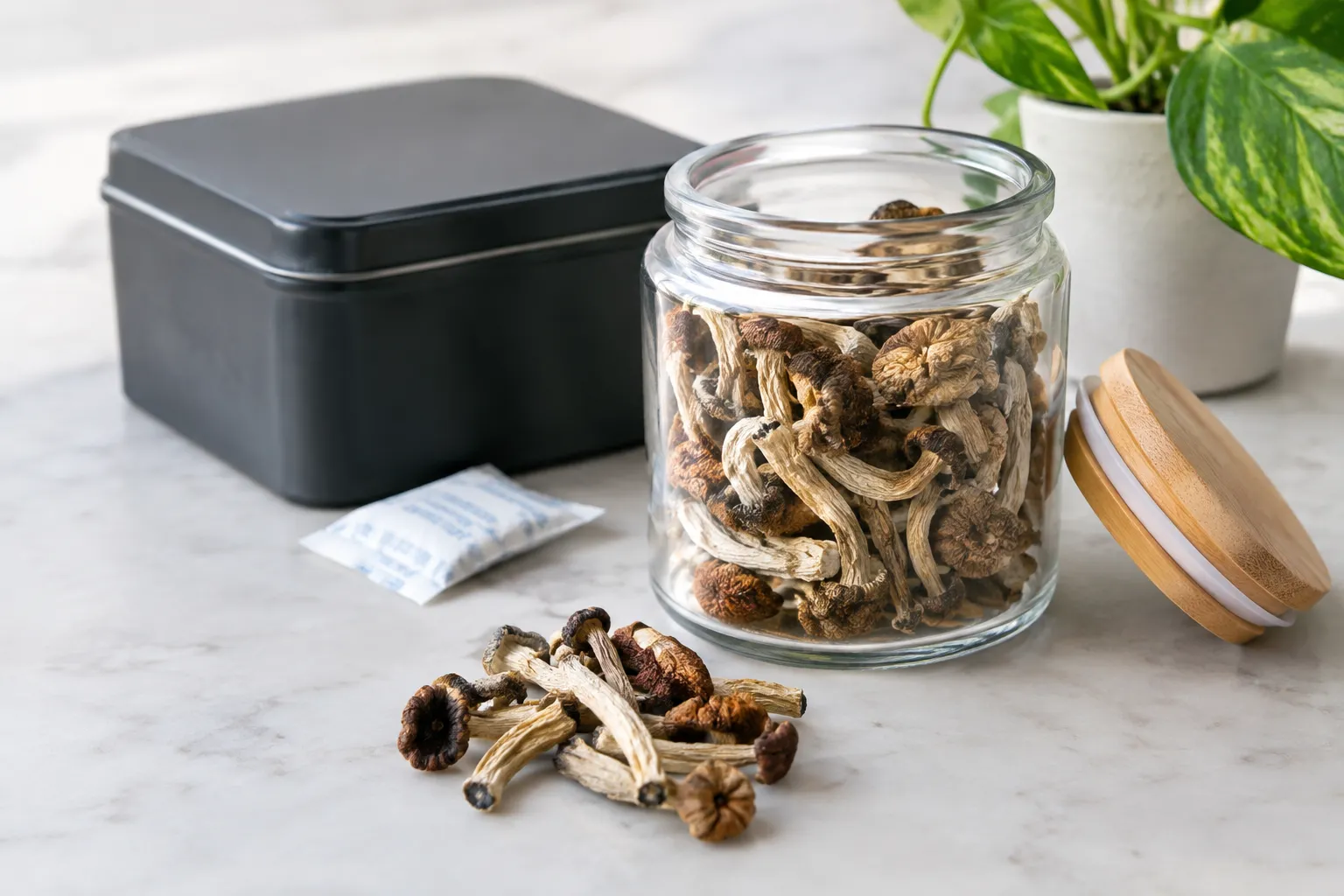
Dry magic mushrooms require protection from conditions that can degrade quality or encourage contamination. Storage information should be specific, and uncertainty should be treated conservatively.
Handling advice is not permission to use an illegal substance. It is practical context for reducing avoidable problems where possession is lawful.
Preserving quality and spotting deterioration
Light, heat, air, and moisture can all affect dried biological material over time. Poorly sealed packaging may allow moisture in, while damp conditions can promote mold or other contamination.
Do not rely on appearance alone to confirm quality. Discard material with visible mold, unexplained wetness, unusual contamination, a strong off odor, or packaging damage that could have exposed it to moisture or debris. When identification or storage history is uncertain, the safest decision is not to use it.
Keep any stored material inaccessible to children, pets, and anyone who might mistake it for ordinary food. Clear labeling and secure storage matter because accidental ingestion can be dangerous.
Do not assume that drying makes mushrooms indefinitely stable. Storage duration depends on how thoroughly the material was dried, the packaging, environmental conditions, and contamination risk. A fixed “safe for” period cannot be responsibly promised without product-specific evidence.
Important health and interaction risks
Psilocybin-containing mushrooms can be associated with altered perception, anxiety, confusion, panic, impaired judgment, nausea, and psychological distress. Responses may be especially unpredictable for people with certain mental health vulnerabilities.
Prescription medications and other substances may interact in ways that are difficult to predict. Anyone taking medication, including psychiatric medication, should speak with a qualified clinician or pharmacist rather than relying on online strain charts.
Avoid driving, swimming, operating machinery, or entering hazardous environments while impaired. Do not use an unknown wild mushroom. If someone develops severe agitation, chest pain, seizures, difficulty breathing, loss of consciousness, dangerous behavior, or cannot be awakened, contact emergency services or poison-control support immediately.
How to compare a mushroom label responsibly
A useful comparison starts with evidence, not with a “top strains” list. Ask what the label actually establishes and what it merely suggests.
Species claims may be more informative than a nickname, but they still need support. Variety names can help organize discussion, but they should not be treated as guarantees of strength or effects. Batch information and testing are more useful when they are specific, current, and connected to the material being described.
A practical comparison framework looks at:
- Identification: Is the claimed species clear, and is there evidence behind it?
- Variety label: Is the name presented as a cultivar description rather than a promise?
- Testing: Does documentation relate to the specific batch?
- Condition: Is the product fresh or dry, and is storage information available?
- Legal status: Are possession, sale, and transport lawful where the reader is located?
- Risk context: Are health, interaction, and impairment concerns acknowledged?
Questions to ask before trusting a comparison
Before accepting a claim about magic mushroom effects, ask whether it is based on laboratory data, a documented batch, repeated controlled research, or anonymous anecdotes. Words such as “guaranteed,” “maximum,” and “the strongest” should prompt extra scrutiny.
Also ask whether the comparison separates species from variety names and fresh material from dry magic mushrooms. If it treats every sample with the same name as chemically identical, it is oversimplifying.
A transparent description should acknowledge uncertainty. It should not imply that a clear-web listing is automatically legitimate, that a dark-web listing is automatically trustworthy, or that payment and shipping language prove product quality.
Why there is no universally strongest strain
There is no reliable universal winner because potency can vary between species, varieties, individual mushrooms, batches, growing conditions, and testing methods. Personal response and context add another layer of variation.
A mushroom described as exceptionally strong may be less potent than another batch carrying a less dramatic name. Without comparable, validated testing, ranked lists are often more entertaining than scientific.
The sensible verdict is not “choose the strongest.” It is “look for the clearest evidence, understand the legal position, and recognize what remains unknown.”
Magic Mushroom Strains FAQ
Which mushroom is considered the most hallucinogenic?
No single mushroom can be declared universally most hallucinogenic because potency varies by species, genetics, batch, testing method, and individual response.
What are the main differences between Psilocybe cubensis and other species?
Psilocybe cubensis is widely discussed as a cultivated species, while other species differ in habitat, appearance, genetics, and reported chemistry; identification and potency remain variable.
Are albino magic mushroom varieties actually different from regular varieties?
Some albino-labeled varieties are cultivated lines with pale features, but appearance alone does not establish a separate species, predictable effects, or greater potency.
Can mushroom appearance reliably show potency?
No. Color, size, bruising, cap shape, and stem thickness cannot reliably determine potency without appropriate testing tied to the specific sample.
Do fresh and dried mushrooms have the same strength?
Fresh and dried mushrooms may contain similar compounds in principle, but their weight and concentration by weight differ because drying removes water; storage can add further uncertainty.
How long can dry magic mushrooms be stored safely?
There is no universal storage duration because drying quality, packaging, heat, light, moisture, and contamination all matter; discard material showing deterioration or uncertain exposure.
Can magic mushrooms interact with prescription medications?
Yes, interactions may be possible and difficult to predict. Anyone taking prescription medication should ask a qualified clinician or pharmacist before considering use.
What should someone do if a mushroom experience becomes frightening or overwhelming?
Move to a calm, safe environment, stay with a trusted sober person, avoid driving or additional substances, and seek emergency help for severe or dangerous symptoms.
Use strain names as clues, not guarantees
Magic mushrooms strains can be useful vocabulary for discussing species and cultivated lines, but the names are not universal standards. They do not guarantee potency, chemistry, duration, or a particular experience.
When comparing a label, prioritize accurate identification, relevant batch information, transparent testing, sensible storage guidance, and current local law. Treat reported magic mushroom effects as variable rather than promised, and remember that dry magic mushrooms can change with handling and storage.
A flashy name may start the conversation. Evidence, caution, and local legal knowledge should finish it.
Mara Whitfield is a senior content editor who makes psychedelic education, cannabis culture, and harm-reduction guidance easier to navigate. She breaks down product formats, dosage considerations, testing, and legal context without the jargon or the guesswork. Her work helps adult readers shop more thoughtfully, protect their privacy, and ask the right questions before exploring microdoses, vapes, teas, and other formats.
